
Natalizumab – the first biosimilar drug for multiple sclerosis and its importance in clinical practice Review article
Article Sidebar
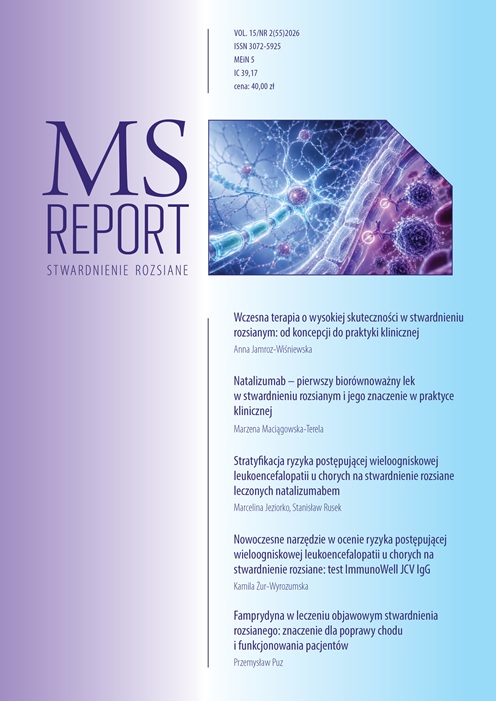
Main Article Content
Abstract
Multiple sclerosis remains one of the most common chronic inflammatory diseases of the central nervous system, and contemporary therapeutic strategies increasingly rely on the early initiation of high-efficacy therapies (HETs). Among these, natalizumab, a monoclonal antibody with well-established efficacy in the treatment of highly active multiple sclerosis, occupies a prominent position.
The aim of this review is to present the role of biosimilars in neurology, with particular emphasis on biosimilar natalizumab (Tyruko®, PB006) as the first biosimilar high-efficacy therapy approved for the treatment of multiple sclerosis. The article discusses the regulatory framework governing the approval of biosimilars, the development program of PB006, and the evidence supporting its analytical, pharmacokinetic, pharmacodynamic, clinical, and immunological equivalence to the reference product.
Current evidence regarding switching from reference natalizumab to its biosimilar is also reviewed, demonstrating the maintenance of efficacy, safety, and comparable immunogenicity. Particular attention is given to the potential role of biosimilar natalizumab in improving access to high-efficacy therapies through the optimization of public healthcare resources and enhanced healthcare system efficiency.
Furthermore, the article highlights the clinical relevance of the intravenous route of natalizumab administration with respect to predictable drug exposure, safety monitoring, and continuity of patient care. The introduction of biosimilar natalizumab may represent an important step toward the broader implementation of high-efficacy treatment strategies, enabling a greater number of patients to benefit from effective therapy while maintaining high standards of efficacy and safety.
Article Details
Copyright ? by Medical Education. All rights reserved.
References
2. Giovannoni G, Butzkueven H, Dhib-Jalbut S et al. Brain health: time matters in multiple sclerosis. Mult Scler Relat Disord. 2016; 9(Suppl 1): S5-48.
3. Hauser SL, Cree BAC. Treatment of multiple sclerosis: a review. Lancet. 2020; 396: 809-20.
4. European Medicines Agency. Biosimilars in the EU: Information Guide for Healthcare Professionals. 2022.
5. IQVIA Institute. The Impact of Biosimilar Competition in Europe. 2023.
6. AG Pro Biosimilars. Market data on biosimilars in Europe. Insight Health database, 2024.
7. Kay J, Schoels MM, Dörner T et al. Task Force on the Use of Biosimilars to Treat Rheumatological Diseases. Consensus-based recommendations for the use of biosimilars to treat rheumatological diseases. Ann Rheum Dis. 2018; 77(2): 165-74. http://doi.org/10.1136/annrheumdis-2017-211937.
8. Polman CH, O’Connor PW, Havrdova E et al. A randomized, placebo-controlled trial of natalizumab for relapsing multiple sclerosis. N Engl J Med. 2006; 354(9): 899-910.
9. European Medicines Agency. EPAR: Tyruko (natalizumab). Amsterdam: EMA; 2024.
10. European Medicines Agency. European Commission grants marketing authorisation for Tyruko (natalizumab). European Medicines Agency; 2024.
11. Chamberlain P, Hemmer B, Höfler J et al. Comparative immunogenicity assessment of biosimilar natalizumab to its reference medicine: a matching immunogenicity profile. Front Immunol. 2024; 15: 1414304. http://doi.org/10.3389/fimmu.2024.1414304.
12. Shirley M. PB006: A Natalizumab Biosimilar. Clin Drug Investig. 2024; 44(5): 367-70.
13. Wessels H, von Richter O, Velinova M et al. Pharmacokinetic and pharmacodynamic similarity of biosimilar natalizumab (PB006) to its reference medicine: a randomized controlled trial. Expert Opin Biol Ther. 2023; 23(12): 1287-97.
14. Hemmer B, Wiendl H, Roth K et al. Efficacy and Safety of Proposed Biosimilar Natalizumab (PB006) in Patients With Relapsing-Remitting Multiple Sclerosis: The Antelope Phase 3 Randomized Clinical Trial. JAMA Neurology. 2023; 80(3): 298-307.
15. European Medicines Agency. Guideline on similar biological medicinal products containing monoclonal antibodies. London: EMA; 2012.
16. Schellekens H. Immunogenicity of therapeutic proteins: clinical implications and future prospects. Clin Ther. 2002; 24(11): 1720-40.
17. Høgestøl EA, Brustad AW, Gulowsen Celius E et al. Real-world experience with switching from originator to biosimilar natalizumab. medRxiv. 2025.02.05.25320428. http://doi.org/10.1101/2025.02.05.25320428.