-
Vol 11 No 2(42) (2021)
Dear Readers,
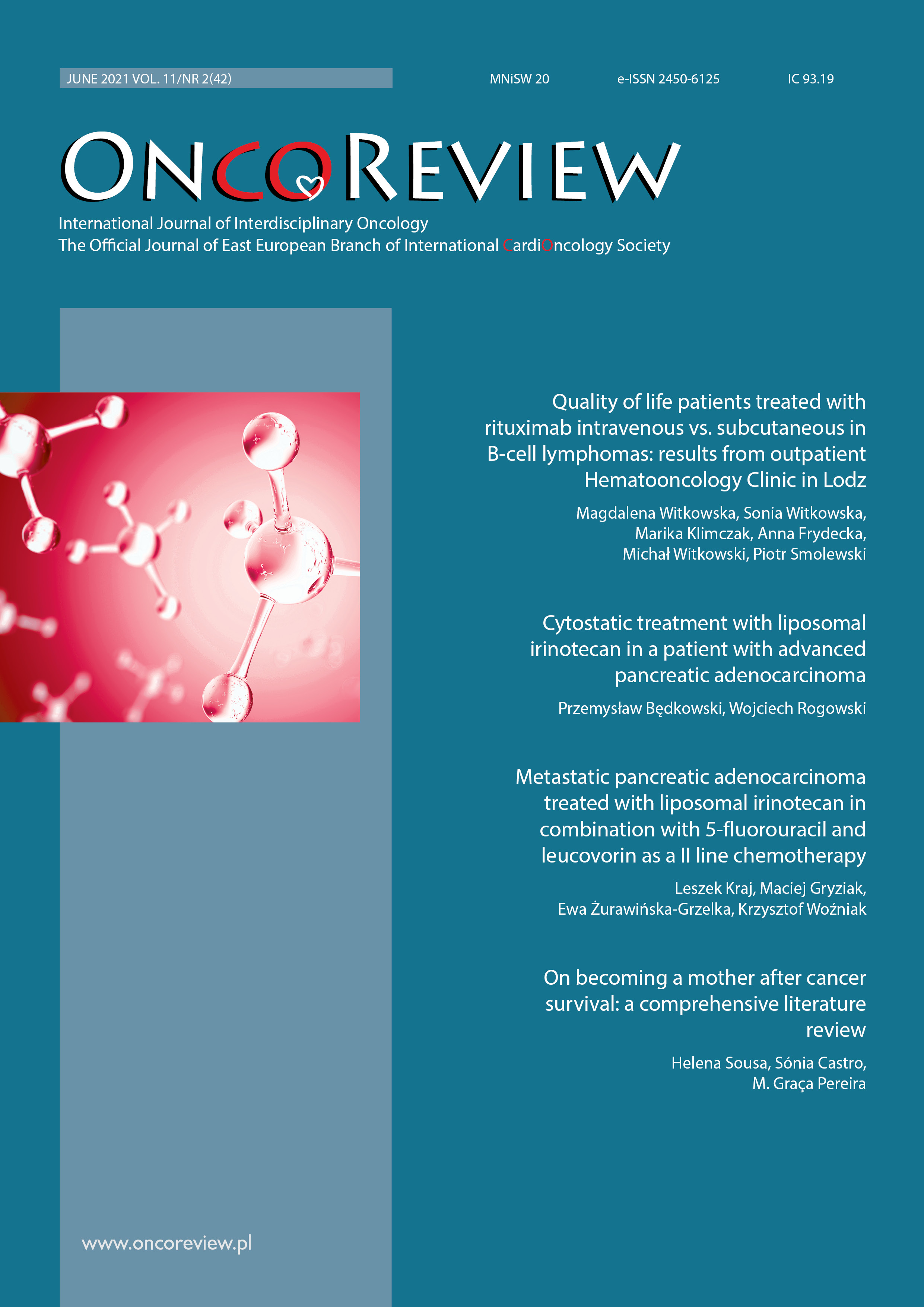
the most recent ?OncoReview? number is in a way unique. What made me use this term? The reason for this is the publication of a review of researchers from leading Portuguese psycho-oncology centers on a particularly important, and at the same time intimate and sensitive sphere, concerning the preservation of fertility by female young cancer survivors, more and more often referred to as oncofertility.
Another presented study is an original report from the Lodz center on improving the quality of life of patients with B-cell lymphoma who were treated with subcutaneous rituximab.
The content of the latest issue of our journal is supplemented by very interesting descriptions of two clinical cases concerning the place of the liposomal form of irinotecan in the treatment of advanced pancreatic adenocarcinoma.
As always, I wish you interesting and stimulating reading,
EDITOR-IN-CHIEF (Europe)
Radosław Grabysa, MD, PhD, Associate Professor -
Vol 11 No 1(41) (2021)
Dear Readers,
I would like to invite you to read the latest, spring issue of ?OncoReview? which opens another year in the development of our magazine.
In the current issue , I recommend to your particular attention an excellent review article by Anna Romaszko-Wojtowicz and Anna Doboszyńska, concerning the so-called ?heat-not-burn? tobacco products, which are to become a new weapon in the fight against the fatal smoking addiction.
With the publication of this paper we would like to open a kind of debate on this ?hot? topic, in which, apart from pulmonologists, oncologists, cardiologists and other specialists will participate.
Oncological therapy with angiogenesis inhibitors is undoubtedly an advancement in modern cancer treatment, however, it is associated with a risk of developing cardiotoxicity, which can manifest in myocardial contractile dysfunction or an increased risk of thromboembolic events. The article by Beata Tomaszewska et al. presents the current state-of-the-art on the mechanisms of cardiotoxicity of antiangiogenic drugs most commonly used in routine clinical practice.
I draw your attention to the description of a very interesting clinical case by Karolina Furgała et al. demonstrating the role of chemotherapy with autologous hematopoietic stem cell transplantation in advanced non-seminoma testicular cancer.
In turn, in the ?OncoWatch? unit, Przemysław Kwiatkowski et al. concisely present tumor lysis syndrome which is rare complication in the course of malignant large B-cell lymphoma.
As always, I wish you developing and inspiring reading,
EDITOR-IN-CHIEF (Europe)
Radosław Grabysa, MD, PhD, Associate Professor -
Special issue 1/2021
TABLE OF CONTENT
TAS-102 ? nowa opcja w leczeniu chorych na zaawansowanego raka jelita grubego po niepowodzeniu lub nietolerancji innych terapii. Piotr Skalij, Piotr Tokajuk, Marek Z. Wojtukiewicz
Długotrwała kontrola choroby podczas terapii TAS-102 w VI linii leczenia u 73-letniego chorego na mCRC. Opis przypadku. Piotr Skalij, Piotr Tokajuk, Stefan Jelski, Marek Z. Wojtukiewicz
Chemioterapia triflurydyną/typiracylem wydłuża czas przeżycia bez progresji i poprawia jakość życia. Opis przypadku 59-letniej kobiety z przerzutowym rakiem odbytnicy. Beata Kania-Zembaczyńska
Skuteczność triflurydyny/typiracylu jako chemioterapii IV linii u młodej kobiety z przerzutowym rakiem jelita grubego. Opis przypadku. Rafał Wiśniowski
Niezwykle wydłużone przeżycie bez progresji choroby po leczeniu triflurydyną/typiracylem. Opis przypadku 57-letniej kobiety z przerzutowym rakiem jelita grubego. Marlena Orlikowska
Długotrwała odpowiedź na terapię triflurydyną z typiracylem w IV linii leczenia u 65-letniego pacjenta z przerzutowym rakiem jelita grubego. Uladzislau Trafimchyk, Lubomir Bodnar
Dwa przypadki długotrwałej kontroli choroby z zastosowaniem triflurydyny z typiracylem w IV linii leczenia zaawansowanego raka jelita grubego. Marcin Sokołowski
Długotrwała stabilizacja choroby u pacjenta leczonego z powodu przerzutowego raka jelita grubego triflurydyną i typiracylem w III linii terapii paliatywnej. Piotr Witasik
Triflurydyna + typiracyl w IV linii leczenia przerzutowego raka jelita grubego. Przemysław Klusek
-
Vol 10 No 4(40) (2020)
Dear Readers,
stereotactic arrhythmia radioablation (STAR) is a novel, last resort treatment method of life-threatening ventricular arrhythmias. The method is based on irradiation of the arrhythmia substrate identified with electrophysiological examination with high-precision image-guided radiosurgical methods usually used for ablation of malignant tumors. We are proud to present the protocol of the first Polish study on STAR in patients with intractable ventricular tachycardia (STAR-VT, nCT04642963) carried out in the Maria Sklodowska-Curie National Research Institute of Oncology in Gliwice, Poland.In the next review article, Dudek et al. in concise form provide practical information on potential biomarkers in early detection of cardiotoxicity due to cancer treatment.
We draw your special attention to the description of a clinical case by Skwierawska et al. concerning cancer-related microangiopathic hemolytic anemia which is rarely recognized as a paraneoplastic syndrome with a very poor prognosis. Monoclonal gammopathy of renal significance (MGRS) means a group of renal diseases resulting from the presence of the monoclonal protein produced by plasmatic cells or other clones of B cells. Kade et al. present current state-of-the-art regarding the diagnostics and treatment of this clinical condition.
?OncoReview? columns are always open to young, promising researchers. In this issue we publish a work from Students? Scientific Organization of Cancer Cell Biology from Medical University of Warsaw, Poland. The paper by Marzec et al. discusses the mainstreaming of effective pain treatment and to review various assessments and scales regarding this important problem.
Sincerely,
EDITOR-IN-CHIEF
Radosław Grabysa, MD, PhD, Associate Professor