
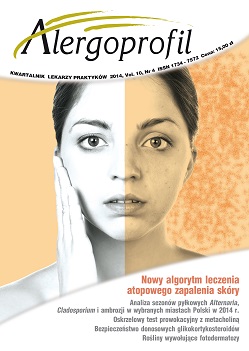
Alternaria spores in the air of selected Polish cities in 2014
Article Sidebar
Main Article Content
Abstract
The aim of the study was to compare the concentration of Alternaria spores in the cities of Szczecin, Warsaw, Zielona Gora, Bialystok, Cracow, Poznan and Lublin in 2014. Measurements were performed by the volumetric method (Burkard and Lanzoni pollen and spores sampler). Alternaria season was defined as the period in which 90% of the annual total catch occurred. The Alternaria season started first in Szczecin (on the 29th April) and in the other cities it started during the next five weeks.
Downloads
Article Details
Copyright: ? Medical Education sp. z o.o. This is an Open Access article distributed under the terms of the Attribution-NonCommercial 4.0 International (CC BY-NC 4.0). License (https://creativecommons.org/licenses/by-nc/4.0/), allowing third parties to copy and redistribute the material in any medium or format and to remix, transform, and build upon the material, provided the original work is properly cited and states its license.
Address reprint requests to: Medical Education, Marcin Kuźma (marcin.kuzma@mededu.pl)
References
2. Lou J., Fu L., Peng Y. et al.: Metabolites from Alternaria fungi and their bioactivities. Molecules 2013, 18: 5891-5935.
3. Escuredo O., Seijo M.O., Fernandez-Gonzalez M. et al.: Effect of meteorological factors on the levels of Alternaria spores on a potato crops. Int. J. Biometeorol. 2011, 55: 243-252.
4. Knutsen A.P., Bush R.K., Demain J.G. et al.: Fungi and allergic lower respiratory tract diseases. Clin. Rev. Allergy Immunol. 2012, 129: 280-290.
5. Skj?th C.A., Sommer J., Frederiksen L. et al.: Crop harvest in Denmark and Central Europe contributes to the local load of airborne Alternaria spore concentrations in Copenhagen. Atmos. Chem. Phys. 2012, 12: 11107-11123.
6. Nikkels A.H., Terstegge P., Spieksma F.T.M.: Ten types of microscopically identifiable airborne fungal spores at Leiden, The Netherlands. Aerobiologia 1996, 12: 107-112.
7. Stępalska D., Harmata K., Kasprzyk I. et al.: Occurrence of airborne Cladosporium and Alternaria spores in Southern and Central Poland in 1995?1996. Aerobiologia 1999, 15: 39-47.
8. Mikali?naité R., Kazlauskas M., Veriankait? L.: Prevalence peculiarities of airborne Alternaria genus spores in different areas of Lithuania. Scientific Works of the Lithuanian Institute of Horticulture and Lithuanian University of Agriculture 2009, 28: 135-143.