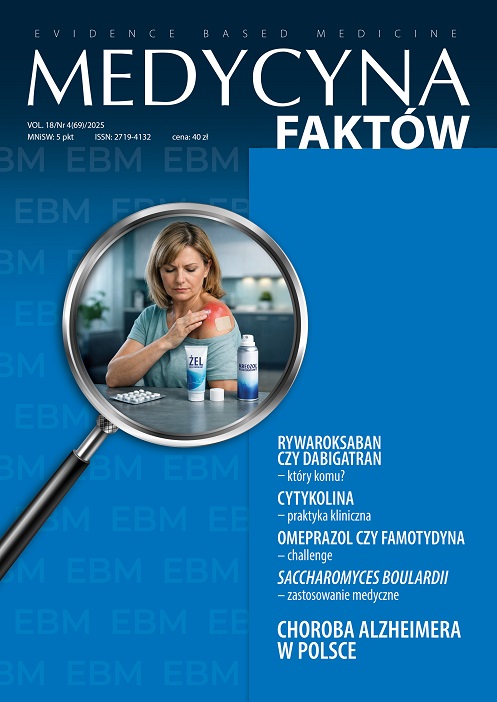
Ketoprofen w sprayu – maksymalna efektywność terapeutyczna zdefiniowana przez penetrację i tolerancję leczenia Artykuł przeglądowy
##plugins.themes.bootstrap3.article.sidebar##
##plugins.themes.bootstrap3.article.main##
Abstrakt
Ostre urazy tkanek miękkich, takie jak skręcenia stawu skokowego w stopniach I i II, to jedne z najczęstszych przyczyn bólu w układzie ruchu, z jakimi stykają się lekarze podstawowej opieki zdrowotnej oraz ortopedzi. Skuteczne leczenie powinno szybko łagodzić ból i obrzęk, a także umożliwiać pacjentom szybki powrót do pełnej sprawności przy jednoczesnym zapewnieniu wysokiego poziomu bezpieczeństwa. Ketoprofen jest niesteroidowym lekiem przeciwzapalnym, który skutecznie łagodzi ból oraz stany zapalne. Jego stosowanie w postaci miejscowej umożliwia skoncentrowanie dużej ilości leku bezpośrednio w obszarze urazu, co minimalizuje ryzyko wystąpienia działań niepożądanych. Dane z badań klinicznych wskazują, że ketoprofen stosowany miejscowo powoduje skuteczną redukcję bólu i obrzęku w ostrych urazach tkanek miękkich. Istotnym czynnikiem wpływającym na skuteczność terapii jest formulacja. Postać sprayu umożliwia lepsze przenikanie ketoprofenu do zapalnych tkanek. W badaniach klinicznych u pacjentów ze skręceniem stawu skokowego wykazano szybszą i większą redukcję bólu oraz obrzęku, a także znaczną poprawę funkcji niż po doustnym podawaniu ketoprofenu. Miejscowe stosowanie ketoprofenu charakteryzuje się dobrą tolerancją i niskim ryzykiem działań niepożądanych, które są typowe dla doustnych niesteroidowych leków przeciwzapalnych. Ketoprofen w formie sprayu to rozsądna opcja terapeutyczna w leczeniu ostrych urazów tkanek miękkich i może być skutecznie stosowany w warunkach ambulatoryjnych.
##plugins.themes.bootstrap3.article.details##
Copyright by Medical Education. All rights reserved.
Bibliografia
2. Fong DT, Hong Y, Chan LK et al. A systematic review on ankle injury and ankle sprain in sports. Sports Med. 2007; 37(1): 73-94. http://doi.org/10.2165/00007256-200737010-00006.
3. Moore N, Pollack C, Butkerait P. Adverse drug reactions and drug-drug interactions with over-the-counter NSAIDs. Ther Clin Risk Manag. 2015; 11: 1061-75. http://doi.org/10.2147/TCRM.S79135.
4. Derry S, Moore RA, Gaskell H et al. Topical NSAIDs for acute musculoskeletal pain in adults. Cochrane Database Syst Rev. 2015; 2015(6): CD007402. http://doi.org/10.1002/14651858.CD007402.pub3.
5. Rainsford KD. Ibuprofen: pharmacology, efficacy and safety. Inflammopharmacology. 2009; 17(6): 275-342. http://doi.org/10.1007/s10787-009-0016-x .
6. Brune K, Patrignani P. New insights into the use of currently available non-steroidal anti-inflammatory drugs. J Pain Res. 2015; 8: 105-18. http://doi.org/10.2147/JPR.S75160.
7. Vinciguerra G, Belcaro G, Cesarone MR et al. Management of uncomplicated ankle sprains with topical or oral ketoprofen treatment. A registry study. Minerva Cardioangiol. 2008; 56(5 Suppl): 47-53.
8. Rother M, Conaghan PG. A randomized, double-blind, phase III trial in moderate osteoarthritis knee pain comparing topical ketoprofen gel with ketoprofen-free gel. J Rheumatol. 2013; 40(10): 1742-8. http://doi.org/10.3899/jrheum.130192.
9. Rainsford KD. Profile and mechanisms of gastrointestinal and other side effects of nonsteroidal anti-inflammatory drugs (NSAIDs). Am J Med. 1999; 107(6A): 27S-35S. http://doi.org/10.1016/s0002-9343(99)00365-4.
10. Esparza F, Cobián C, Jiménez JF et al.; Working group for the acute pain study of SETRADE. Topical ketoprofen TDS patch versus diclofenac gel: efficacy and tolerability in benign sport related soft-tissue injuries. Br J Sports Med. 2007; 41(3): 134-9.
11. Lanas A, Ferrandez A. NSAID-induced gastrointestinal damage: current clinical management and recommendations for prevention. Chin J Dig Dis. 2006; 7(3): 127-33. http://doi.org/10.1111/j.1443-9573.2006.00257.x.
12. Singh P, Roberts MS. Skin permeability and local tissue concentrations of nonsteroidal anti-inflammatory drugs after topical application. J Pharmacol Exp Ther. 1994; 268(1): 144-51.
13. Brune K, Hinz B. The discovery and development of antiinflammatory drugs. Arthritis Rheum. 2004; 50(8): 2391-9. http://doi.org/10.1002/art.20424.
14. Goodwin DA, Fuhrman LC. Enhancement of skin penetration of nonsteroidal anti-inflammatory drugs from extemporaneously compounded topical-gel formulations. Int J Pharm Compd. 1999; 3(6): 496-500.
15. Mason L, Moore RA, Edwards JE et al. Topical NSAIDs for acute pain: a meta-analysis. BMC Fam Pract. 2004; 5: 10. http://doi.org/10.1186/1471-2296-5-10.
16. van den Bekerom MPJ, Sjer A, Somford MP et al. Non-steroidal anti-inflammatory drugs (NSAIDs) for treating acute ankle sprains in adults: benefits outweigh adverse events. Knee Surg Sports Traumatol Arthrosc. 2015; 23(8): 2390-99. http://doi.org/10.1007/s00167-014-2851-6.
17. Bally M, Dendukuri N, Rich B et al. Risk of acute myocardial infarction with NSAIDs in real world use: bayesian meta-analysis of individual patient data. BMJ. 2017; 357: j1909. http://doi.org/10.1136/bmj.j1909.