Skuteczna suplementacja Saccharomyces boulardii w leczeniu i profilaktyce biegunek różnego pochodzenia Artykuł przeglądowy
##plugins.themes.bootstrap3.article.sidebar##
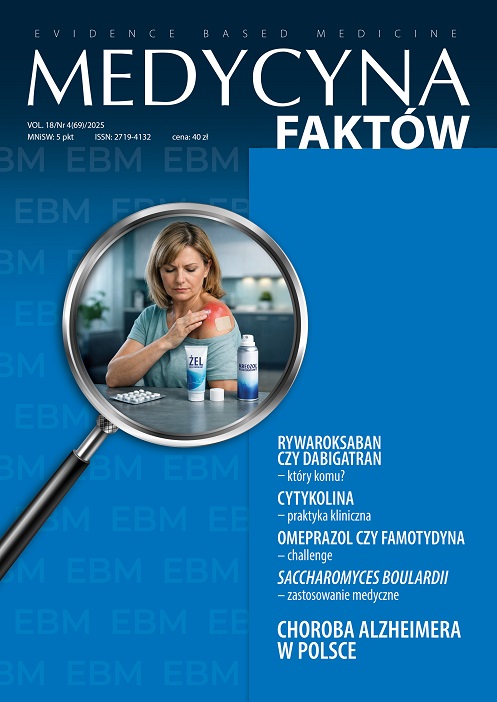
##plugins.themes.bootstrap3.article.main##
Abstrakt
Biegunki to powszechny problem zdrowotny u dorosłych i dzieci – stanowią one jedną z głównych przyczyn wizyt lekarskich, zwłaszcza w przypadku dzieci oraz osób zmagających się z ostrym przebiegiem objawów wywołanych m.in. przez infekcje. Standardowa terapia obejmuje doustną rehydratację oraz suplementację cynkiem, co skutecznie zmniejsza ryzyko ciężkiego odwodnienia i skraca czas trwania epizodu, nie eliminując jednak zaburzeń czynnościowych jelit. Coraz więcej dowodów wskazuje, że w patofizjologii biegunek kluczową rolę odgrywają zaburzenia mikrobioty jelitowej oraz uszkodzenie bariery jelitowej, co uzasadnia stosowanie probiotyków jako uzupełnienia terapii. Saccharomyces boulardii jest jedynym drożdżakiem probiotycznym, którego skuteczność w leczeniu biegunek została udokumentowana w badaniach randomizowanych. Szczep CNCM I-3799 wyróżnia się dużą żywotnością komórek i stabilnością preparatu, co zapewnia powtarzalność efektu klinicznego. Mechanizm działania obejmuje neutralizację toksyn bakteryjnych, ograniczenie kolonizacji jelit przez patogeny, wspieranie odbudowy mikrobioty, stabilizację połączeń ścisłych nabłonka jelitowego oraz modulację odpowiedzi immunologicznej. Drożdżak ogranicza także przerost Candida albicans w mechanizmie hamowania biofilmu i aktywacji mechanizmów odpornościowych. W badaniach klinicznych podawanie S. boulardii CNCM I-3799 skracało czas trwania ostrej biegunki średnio o blisko 30 h i przyspieszało powrót do zdrowia. W profilaktyce biegunki poantybiotykowej i biegunki podróżnych szczep ten okazał się bardzo skuteczny u dzieci i dorosłych przy minimalnym ryzyku działań niepożądanych. Drożdżak nie kolonizuje trwale jelit i jest eliminowany po zakończeniu suplementacji. Saccharomyces boulardii CNCM I-3799 stanowi skuteczne i bezpieczne uzupełnienie terapii oraz profilaktyki biegunek, zapewnia wielokierunkowe wsparcie jelitowej homeostazy i poprawę wyników klinicznych u pacjentów wrażliwych na zaburzenia funkcji jelit.
##plugins.themes.bootstrap3.article.details##
Copyright by Medical Education. All rights reserved.
Bibliografia
2. Mourey F, Sureja V, Kheni D et al. A Multicenter, Randomized, Double-blind, Placebo-controlled Trial of Saccharomyces boulardii in Infants and Children With Acute Diarrhea. Pediatr Infect Dis J. 2020; 39(11): e347-51. http://doi.org/10.1097/INF.0000000000002849.
3. Fu J, Liu J, Wen X et al. Unique Probiotic Properties and Bioactive Metabolites of Saccharomyces boulardii. Probiotics Antimicrob Proteins. 2023; 15(4): 967-82. http://doi.org/10.1007/s12602-022-09953-1.
4. McFarland LV, Li T. Efficacy and safety of Saccharomyces boulardii CNCM 1-745 for the treatment of pediatric acute diarrhea in China: a systematic review and meta-analysis. Front Cell Infect Microbiol. 2025; 15: 1587792. http://doi.org/10.3389/fcimb.2025.1587792.
5. Czerucka D, Rampal P. Diversity of Saccharomyces boulardii CNCM I-745 mechanisms of action against intestinal infections. World J Gastroenterol. 2019; 25(18): 2188-203. http://doi.org/10.3748/wjg.v25.i18.2188.
6. Pais P, Almeida V, Yılmaz M et al. Saccharomyces boulardii: What Makes It Tick as Successful Probiotic? J Fungi (Basel). 2020; 6(2): 78. http://doi.org/10.3390/jof6020078.
7. Kelesidis T, Pothoulakis C. Efficacy and safety of the probiotic Saccharomyces boulardii for the prevention and therapy of gastrointestinal disorders. Ther Adv Gastroenterol. 2012; 5(2): 111-25. http://doi.org/10.1177/1756283X11428502.
8. Moré MI, Swidsinski A. Saccharomyces boulardii CNCM I-745 supports regeneration of the intestinal microbiota after diarrheic dysbiosis – a review. Clin Exp Gastroenterol. 2015; 8: 237-55. http://doi.org/10.2147/CEG.S85574.
9. Jawhara S, Habib K, Maggiotto F et al. Modulation of Intestinal Inflammation by Yeasts and Cell Wall Extracts: Strain Dependence and Unexpected Anti-Inflammatory Role of Glucan Fractions. PLoS One. 2012; 7(7): e40648. http://doi.org/10.1371/journal.pone.0040648.
10. Ghosh A, Sundaram B, Bhattacharya P et al. Effect of Saccharomyces boulardii CNCM-I 3799 and Bacillus subtilis CU-1 on Acute Watery Diarrhea: A Randomized Double-Blind Placebo-Controlled Study in Indian Children. Pediatr Gastroenterol Hepatol Nutr. 2021; 24(5): 423-31. http://doi.org/10.5223/pghn.2021.24.5.423.
11. Wang D, Li C, Lai J et al. Therapeutic potential of Saccharomyces boulardii in alleviating gastrointestinal stress through preservation of intestinal cell membrane integrity. BMC Microbiol. 2025; 25(1): 359. http://doi.org/10.1186/s12866-025-03984-8.
12. Waitzberg D, Guarner F, Hojsak I et al. Can the Evidence-Based Use of Probiotics (Notably Saccharomyces boulardii CNCM I-745 and Lactobacillus rhamnosus GG) Mitigate the Clinical Effects of Antibiotic-Associated Dysbiosis? Adv Ther. 2024; 41(3): 901-14. http://doi.org/10.1007/s12325-024-02783-3.
13. bbMcFarland LV. Systematic review and meta-analysis of Saccharomyces boulardii in adult patients. World J Gastroenterol. 2010; 16(18): 2202-22. http://doi.org/10.3748/wjg.v16.i18.2202.
14. Li M, Xie Y. Efficacy and safety of Saccharomyces boulardii as an adjuvant therapy for the eradication of Helicobacter pylori: a meta-analysis. Front Cell Infect Microbiol. 2025; 15: 1441185. http://doi.org/10.3389/fcimb.2025.1441185.
15. Ling H, Liu R, Sam QH et al. Engineering of a probiotic yeast for the production and secretion of medium-chain fatty acids antagonistic to an opportunistic pathogen Candida albicans. Front Bioeng Biotechnol. 2023; 11: 1090501. http://doi.org/10.3389/fbioe.2023.1090501.
16. Wei Y, Qiu J, Han Z et al. Antifungal bio-coating of endotracheal tube built by overexpressing the MCP1 gene of Saccharomyces boulardii and employing hydrogel as a „house” to antagonize Candida albicans. Biomater Res. 2023; 27(1): 97. http://doi.org/10.1186/s40824-023-00443-1.
17. Murzyn A, Krasowska A, Stefanowicz P et al. Capric acid secreted by S. boulardii inhibits C. albicans filamentous growth, adhesion and biofilm formation. PLoS One. 2010; 5(8): e12050. http://doi.org/10.1371/journal.pone.0012050.
18. Abid R, Waseem H, Ali J et al. Probiotic Yeast Saccharomyces: Back to Nature to Improve Human Health. J Fungi (Basel). 2022; 8(5): 444. http://doi.org/10.3390/jof8050444.
19. Szajewska H, Kołodziej M, Zalewski BM. Systematic review with meta-analysis: Saccharomyces boulardii for treating acute gastroenteritis in children – a 2020 update. Aliment Pharmacol Ther. 2020; 51(7): 678-88. http://doi.org/10.1111/apt.15659.
20. Szajewska H, Canani RB, Guarino A et al. Probiotics for the Prevention of Antibiotic-Associated Diarrhea in Children. J Pediatr Gastroenterol Nutr. 2016; 62(3): 495-506. http://doi.org/10.1097/MPG.0000000000001081.
21. Szajewska H. Saccharomyces boulardii – aktualne dane naukowe. Prz Gastroenterol. 2012; 7(6): 351-8. http://doi.org/10.5114/pg.2012.33042.
22. McFarland LV, Srinivasan R, Setty RP et al. Specific Probiotics for the Treatment of Pediatric Acute Gastroenteritis in India: A Systematic Review and Meta-Analysis. JPGN Rep. 2021; 2(3): e079. http://doi.org/10.1097/PG9.0000000000000079.
23. Chitapanarux T, Wiracha U, Winichakoon P et al. Efficacy and safety of Saccharomyces boulardii as adjunct therapy with Vancomycin in treating Clostridioides difficile infection: A randomized controlled trial. Sci Rep. 2025; 15: 19326. https://doi.org/10.1038/s41598-025-04986-2.
24. Maev I, Andreev D, Shaburov R et al. [Study on the efficacy of combination therapy with rifaximin and Saccharomyces boulardii CNCM I-745 in patients with small intestinal bacterial overgrowth associated with long-term use of proton pump inhibitors]. Terapevticheskii arkhiv. 2025; 97(8): 660-7. https://doi.org/10.26442/00403660.2025.08.203301.