
Profiles of patients who may benefit from therapeutic doses of trazodone in the treatment of depression Case report
Article Sidebar
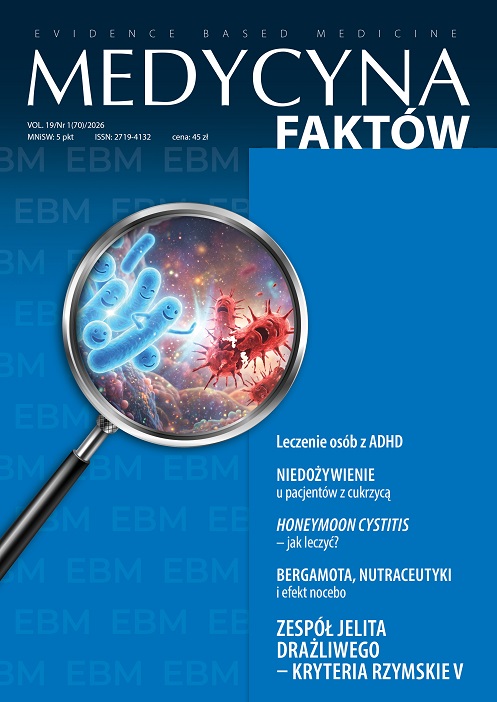
Main Article Content
Abstract
Effective treatment of depression with trazodone requires the use of therapeutic doses above 150 mg (most commonly in the range of 225–300 mg), which correspond to the full antidepressant dose range. The extended-release (XR) formulation provides stable plasma concentrations, good tolerability, and convenient once-daily dosing, thereby supporting adherence and long-term treatment. This article presents clinical profiles of patients in whom the use of therapeutic doses of trazodone XR as monotherapy for depression is particularly justified. These include, among others, older adults with masked depression and polypharmacy, professionally active individuals, young adults with prominent tension and sleep disturbances, patients with irritability and anger outbursts, individuals with comorbid medical conditions, as well as patients requiring special caution due to cardiovascular or neurological comorbidities. A common feature of these profiles is the need for a treatment approach that addresses not only mood symptoms but also sleep, anxiety, tension, and overall functioning, while at the same time minimizing polypharmacy and the risk of adverse effects. The aim of this paper is to highlight the clinical importance of appropriate dosing of trazodone XR and the role of individualized treatment of depression based on predominant symptoms, somatic comorbidities, and patients’ functional expectations.
Article Details
Copyright by Medical Education. All rights reserved.
References
2. Stahl SM. Mechanism of action of trazodone: a multifunctional drug. CNS Spectr. 2009; 14(10): 536-46.
3. Sheehan DV, Croft HA, Gossen ER et al. Extended-release trazodone in major depressive disorder: a randomized, double-blind, placebo-controlled study. Psychiatry (Edgemont). 2009; 6(5): 20-33.
4. Dudek D, Chrobak AA, Krupa AJ et al. TED-trazodone effectiveness in depression: a naturalistic study of the effectiveness of trazodone in extended release formulation compared to SSRIs in patients with a major depressive disorder. Front Pharmacol. 2023; 14: 1296639.
5. Shahpesandy H. Different manifestation of depressive disorder in the elderly. Neuro Endocrinol Lett. 2005; 26(6): 691-5.
6. Fernandez-Rodrigues V, Sanchez-Carro Y, Lagunas LN et al. Risk factors for suicidal behaviour in late-life depression: A systematic review. World J Psychiatry. 2022; 12(1): 187-203.
7. Beghi M, Butera E, Cerri CG et al. Suicidal behaviour in older age: A systematic review of risk factors associated to suicide attempts and completed suicides. Neurosci Biobehav Rev. 2021; 127: 193-211.
8. Wichniak A, Bieńkowski P, Dąbrowski R et al. Leczenie bezsenności osób w starszym wieku. Zalecenia Polskiego Towarzystwa Badań nad Snem, Polskiego Towarzystwa Medycyny Rodzinnej i Polskiego Towarzystwa Psychiatrycznego. Psychiatr Pol. 2023; 57(3): 495-516.
9. Varghese D, Ishida C, Patel P et al. Polypharmacy. StatPearls [Internet], 2024.
10. Fagiolini A, Pinto AG, Woznica Miskowiak K et al. Trazodone in the Management of Major Depression Among Elderly Patients with Dementia: A Narrative Review and Clinical Insights. Neuropsychiatr Dis Treat. 2023; 19: 2817-283.
11. Cuomo A, Bianchetti A, Cagnin A et al. Trazodone: a multifunctional antidepressant. Evaluation of its properties and real-world use. Journal of Gerontology and Geriatrics. 2021; 69: 120-29.
12. Rivasi G, Capacci M, Del Re LM et al. Trazodone and Risk of Orthostatic Hypotension, Syncope and Falls in Geriatric Outpatients with Hypertension. Observational Study Drugs Aging. 2025; 42(4): 373-80.
13. Zhou S, Li P, Lv X et al. Adverse effects of 21 antidepressants on sleep during acute-phase treatment in major depressive disorder: a systemic review and dose-effect network meta-analysis. Sleep. 2023; 46(10): zsad177.
14. Rothmore J. Antidepressant-induced sexual dysfunction. Med J Aust. 2020; 212(7): 329-34.
15. Goodwin GM, Price J, De Bodinat C et al. Emotional blunting with antidepressant treatments: A survey among depressed patients. J Affect Disord. 2017; 221: 31-5.
16. Siwek M, Chrobak AA, Dudek D et al. Trazodone effectiveness in depression: impacts of trazodone extended release vs SSRIs on the health status and quality of life of patients with major depressive disorder. Front Pharmacol. 2024; 15: 1525498.
17. Sinclair LI, Christmas DM, Hood SD et al. Antidepressant-induced jitteriness/anxiety syndrome: systematic review. BMJ. 2009; 339: b4736.
18. Baldwin DS, Foong T. Antidepressant drugs and sexual dysfunction. Br J Psychiatry. 2013; 202(6): 396-7.
19. Price J, Cole V, Goodwin GM. Emotional blunting with antidepressant treatments: a survey among depressed patients. J Affect Disord. 2009; 117(1-2): 91-5.
20. Read J, Cartwright C, Gibson K. Adverse emotional and interpersonal effects reported by 1829 New Zealanders while taking antidepressants. Soc Psychiatry Psychiatr Epidemiol. 2014; 49(10): 1569-78.
21. Fagiolini A, Albert U, Maina G et al. Role of trazodone in the treatment of major depressive disorder: a narrative review. Ann Gen Psychiatry. 2023; 22: 27.
22. Montejo AL, Llorca G, Izquierdo JA et al. Incidence of sexual dysfunction associated with antidepressant agents: a prospective multicenter study. J Sex Marital Ther. 2001; 27(2): 111-23.
23. Fava M, Hwang I, Rush AJ et al. The importance of irritability as a symptom of major depressive disorder: results from the National Comorbidity Survey Replication. J Clin Psychiatry. 2010; 71(12): 1594-602.
24. Fava M, Mischoulon D. Anger, hostility, and irritability in major depressive disorder. CNS Spectr. 2016; 21(2): 95-102.
25. Read JR, Sharpe L, Modini M et al. Multimorbidity and depression: A systematic review and meta-analysis. J Affect Disord. 2017; 221: 36-46.
26. Jeffery A, Bhanu C, Walters K et al. Polypharmacy and antidepressant acceptability in comorbid depression and type 2 diabetes: a cohort study using UK primary care data. Br J Gen Pract. 2023; 73(730): e392-8.
27. Yuan Y, Tsoi K, Hunt RH. Selective serotonin reuptake inhibitors and risk of upper GI bleeding: confusion or confounding? Am J Med. 2006; 119(9): 719-27.
28. Gheysens T, Van Den Eede F, De Picker L. The risk of antidepressant-induced hyponatremia: A meta-analysis of antidepressant classes and compounds. Eur Psychiatry. 2024; 67(1): e20.
29. Dołoto A, Bąk E, Batóg G et al. Interactions of antidepressants with concomitant medications-safety of complex therapies in multimorbidities. Pharmacol Rep. 2024; 76(4): 714-39.
30. Siwek M. Dekalog leczenia depresji. ITEM Publishing, Warszawa 2024.
31. Glassman AH, O’Connor CM, Califf RM et al. Sertraline Treatment of Major Depression in Patients With Acute Myocardial Infarction or Unstable Angina: The SADHART Randomized Trial. JAMA. 2002; 288(6): 701-9.
32. Aarsland D, Påhlhagen S, Ballard CG et al. Depression in Parkinson disease – epidemiology, mechanisms and management. Nat Rev Neurol. 2011; 8(1): 35-47.
33. Seppi K, Weintraub D, Coelho M et al. The Movement Disorder Society Evidence-Based Medicine Review Update: Treatments for the Non-Motor Symptoms of Parkinson’s Disease. Mov Disord. 2011; 26 (03): S42-80.
34. Frenklach A. Management of Depression in Parkinson’s Disease. Am J Psychiatry Resid J. 2016; 11(4): 8-11.
35. Panisset M, Chen JJ, Rhyee SH et al.; STACCATO study investigators: Serotonin toxicity association with concomitant antidepressants and rasagiline treatment: retrospective study (STACCATO). Pharmacotherapy. 2014; 34(12): 1250-8.